Residential Energy Efficiency Can Deliver Major Grid Benefits Amidst Wisconsin’s Data Center Boom
By: Ariya Shah and Elizabeth Hittman (Elevatenp.org)
On May 27th, Elevate joined Green Homeowners United for a press conference at the Wisconsin State Capitol in Madison to discuss new research on how energy efficiency programs can help combat rising energy bills and increased grid demand from data centers. The research shows that investing in home energy efficiency upgrades is one of the most affordable energy solutions to address growing data center demand, second only to wind energy.
The Green Homeowners United report provides insights into the most effective opportunities for substantial electricity savings and how these savings can reduce strain from incoming data centers, echoing the message that energy efficiency not only yields large benefits for individual homeowners, but for the entire grid. Recent analysis by ACEEE shows that investing in energy efficiency and demand flexibility is critical to reduce data center demand growth and high infrastructure costs. For example, Google estimates that over a recent 12-month period, the energy footprint of the median Gemini text prompt 33 times, driven by an investment in software efficiency efforts and clean energy procurement. The Green Homeowners United report shows that residential energy efficiency upgrades can bring similar energy saving benefits to the grid and families.
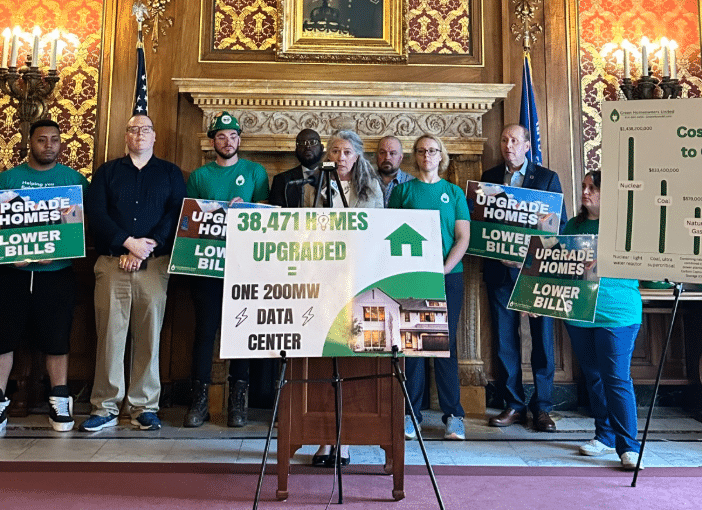
Photo: Abby Corso, Elevate’s Chief Strategy Officer, speaking at the Wisconsin State Capitol, May 27, 2026
Elevate’s Chief Strategy Officer Abby Corso spoke to some of these benefits as she shared success stories from the first five years of Elevate and Sustain Dane’s Dane County Efficiency Navigator program, which projected annual energy savings of $43,000 from energy efficiency upgrades in Wisconsin homes. When asked about the Efficiency Navigator program, Allie Berenyi, Construction Manager at Elevate, said “When these improvements are applied in multifamily homes, such as those served through Dane County’s Efficiency Navigator program, the savings go directly into the pockets of renters, who are often the most sensitive to energy price hikes and who have the least agency to improve the efficiency of their homes. At the same time, building owners who might not have the wherewithal to make these improvements are happy to improve their buildings and the quality of life of their tenants. Everyone wins.”
The GHU report also identifies exactly which upgrades yield the most benefits for homeowners. Based on data analyzed from 200 income-qualifying energy assessments in Milwaukee and La Crosse, the highest savings opportunities come from basement insulation, saving homeowners an average of $173/year and up to $580/year. Attic insulation and air sealing were found to save on average $55/year and $64/year, respectively. Additionally, the report found that upgrading 38,471 Wisconsin homes to be at least 20% more energy efficient can approximately offset the energy demand of one 200MW data center, an option second only to wind energy in cost effectiveness.
| One 200 MW Data Center: Energy Efficiency Upgrades vs. New Generation | ||
| Energy Generation/Savings Type | Prices based on planned base overnight costs of new electricity generating stations in the United States in 2024 | |
| Residential energy efficiency upgrades, City of Milwaukee only | $1,384 per kw | $276,771,100* |
| Wind | $1,452 per kw | $290,400,000 |
| Residential energy efficiency upgrades, both cities | $1,577 per kw | $315, 464, 915** |
| Solar photovoltaic with storage | $1,590 per kw | $318,000,000 |
| Residential energy efficiency upgrades, City of La Crosse only | $1,834 per kw | $366,736,254*** |
| Natural gas combined cycle power plants with Carbon Capture and Storage (CCS) | $2,895 per kw | $579,000,000 |
| Coal, ultra supercritical | $4,167 per kw | $833,400,000 |
| Nuclear – light water reactor | $7,191 per kw | $1,438,200,000 |
| *33,753 Milwaukee homes times $8,200 average project price to achieve 20%+ BTU savings | ||
| **38,471 homes times $8,200 average project price to achieve 20%+ BTU savings | ||
| ***44,724 La Crosse homes times $8,200 average project price to achieve 20%+ BTU savings | ||
Table 1: Cost comparison to power one 200 MW data center (data adapted from Green Homeowners United 2026 Report)
These findings have implications for consumers, utilities, and policymakers alike. For Wisconsin specifically, an aging housing stock represents an opportunity for immediate homeowner savings, especially under the IRA HOMES rebates for income-qualifying households. Further, the rapid expansion of data centers across the state, with over 15 new data centers being considered in Mount Pleasant, WI alone, creates the need for urgent action. Scaling residential efficiency programs is not only cheaper, but also faster than constructing new generation capacity, which takes years.
The report concludes by outlining key policy levers to increase community adoption of efficiency programs, including rewarding utilities for incentivizing residential energy efficiency as well as increasing funding for Wisconsin’s Focus on Energy program for residential projects, as was proposed in Governor Tony Evers’ 2025 budget proposal.
The evidence in the report provides some rare reassurance in the face of uncertainty surrounding data centers in the Midwest; investing in residential energy efficiency—improving the infrastructure we already have—can accommodate a significant portion of growing demand, without having to invest in the large infrastructure that drives electricity costs up. But, while the potential of energy efficiency programs is significant, Kevin Kane of Green Homeowners United adds that it is not a ‘silver bullet’ solution: responding to rising energy prices will require a portfolio of strategies, of which energy efficiency is an important piece.
Learn more about energy efficiency upgrades and the potential to reduce energy demand at elevatenp.org.